Wednesday, June 8, 2011

Symbols Quiz


Answer the following questions in your social studies notebooks. You may use your notes.

1) What is a symbol?

2) Draw two examples of a symbol.

3) Can more than one symbol stand for the same thing? Give an example.

4) What is the Liberty Bell a symbol of?

5) The ____________ is the national bird. It represents ___________ and _____________.

6) Name two buildings that stand for the United States and write down what happens in them.

Tuesday, May 31, 2011

Rights and Responsibilities Quiz


Answer the following questions in your social studies notebooks. You may use your notes.

1) Define "citizen."

2)Everyone has a ______________ to be a good citizen.

3) Define "responsibility." Name three responsibilities that you have.

4) What is a law? Name three things that there are laws against.

5) Define a "right."

6) Name three freedoms in the Bill of Rights.

7. Name a right you have in school that is also a responsibility. Explain how it is both.

Friday, May 27, 2011

Map Quiz


Answer the following questions in your social studies notebooks. You may use your notes.

1) What kind of map shows boundaries of places like countries, states and cities?

2) What tells you the difference in scale between a map and real life?

3) Name three things that maps have in common.

4) What kind of map would you use if you were studying the Civil War? Why?

5) What kind of map would you use to drive from your house in New York to Florida? Why

6) If you were stuck on a desert island, what kind of map might best help get off the island? Why?

Monday, April 4, 2011

Document Based Question: Erie Canal

Transportation systems often have a big impact on communities. In 1825 the Erie Canal opened in New York State.

Read the documents below. For each document answer the questions that follow. After reading the documents and answering the questions, write a composition that explains how the Erie Canal affected New York State’s development.

Document A: Map of Erie Canal


1. What are four major cities along the Erie Canal?

__________________________________________________________________________

2. What waterway connected the Erie Canal to New York City?


Document B: Chart on Erie Canal


1. How long did it take to ship freight along the Erie Canal during the Canal Era?

__________________________________________________

2. Give two advantages of using the Erie Canal instead of dirt roads to transport freight during the Erie Canal.

a) __________________________________________________________________________

__________________________________________________________________________

b) __________________________________________________________________________

__________________________________________________________________________


Document C: State of New York Report on The Barge Canal


New York City was ranked fourth in population in 1800 rose to first place . . . Albany doubled its population within a few years. The population of Utica increased from 3,000 to 13,000 in twenty years. Syracuse, which was described as a "desolate" hamlet of a few scattered wooden houses in 1820, became a city of 11,000 in 1840. During approximately the same period, Rochester changed from "one wide and deep forest" to a prosperous community of 20,000. Buffalo, a wilderness outpost of 200 in 1812, became a gateway to the west and its population reached 18,000 by 1840.

State of New York Report on The Barge Canal, Legislative Document 1961

1. What was the population of Buffalo in 1840?

__________________________________________________________________________


2. What effect did the Erie Canal have on the cities located along the Canal?

__________________________________________________________________________

__________________________________________________________________________


Document D: Photo


1. Where and when was this photo taken?

__________________________________________________________________________


2. Looking at the photograph, what impact did the Erie Canal have on Rochester?

__________________________________________________________________________


__________________________________________________________________________


Document E: Engineer’s Report on Erie Canal

"the uniting of Lake Erie with the Hudson [will] render New York the greatest commercial emporium [city] in the world…The expense, be it what it may, is no object when compared with the incalculable benefit…For these reasons I strongly recommend the adoption of the plan."

William Weston, Engineer, 1807


1. Why does William Weston favor building the Erie Canal?

__________________________________________________________________________

__________________________________________________________________________


Essay

Transportation systems often have a big impact on communities. In 1825 the Erie Canal opened in New York State. Write an essay explaining how the Erie Canal affected New York State’s development. Use the documents above to help you answer the question.

Tuesday, March 29, 2011

The Erie Canal


Erie Canal was the first important national waterway built in the United States. It crossed upstate New York from Buffalo on Lake Erie to Albany to Troy on the Hudson River. Completed in 1825, the canal joined the Atlantic Ocean with the Great Lakes system. It provided a route over which manufactured goods and settlers could flow into the Midwest without passing through Canada, and over which timber and agricultural products could be transported to the East.

For a hundred years before the Erie Canal was built, people had been talking about a canal that would join the Great Lakes and the Atlantic Ocean. The man who planned the Erie Canal and carried the plans through was De Witt Clinton. Clinton was mayor of New York City for most of the period between 1803 and 1815. He was governor of the state from 1817 to 1822 and again from 1825 until his death in 1828. Those who opposed the canal laughingly called it “Clinton’s Ditch.”

Clinton and Gouverneur Morris went to Washington in 1812 to ask for federal help for the project, but they were unsuccessful. In 1816, Clinton petitioned the New York State Legislature to build the canal. His petition won so much support that the governor appointed a canal commission and made Clinton its head. Clinton became governor in 1817, and shortly afterward, on July 4, 1817, broke ground for the canal in Rome, New York, then a village on the Mohawk River. Construction took eight years. The canal formally opened on Oct. 26, 1825. The first barge to travel its entire length, the Seneca Chief, left Buffalo with Clinton on board on Oct. 26, 1825. It arrived in New York City on November 4 and was greeted all along the way by enthusiastic crowds.

The building of the canal was paid for by the state of New York. It cost $7,143,789, but it soon earned its price many times over. The canal cut freight rates between Buffalo and New York City by more than 90 percent and strengthened New York City’s position as the nation’s largest city and principal port. As the canal traffic grew, towns along its course prospered. Albany, Utica, Syracuse, Rochester, and Buffalo became major cities.

The original canal was 363 miles (584 kilometers) long. It was 28 feet (8.5 meters) wide at the bottom, 40 feet (12 meters) wide at the top, and 4 feet (1.2 meters) deep. It could carry barges that were 80 feet (24 meters) long and 15 feet (4.6 meters) wide, with a draft of 31/2 feet (1.1 meters). The canal had 83 locks, which raised vessels on the canal about 565 feet (172 meters) from the Hudson River to Lake Erie. Barges were towed along the canal by horses and mules on shore. At first, travel on the canal was slow. The famous editor Horace Greeley wrote that passengers traveled a mile and a half an hour on the Erie Canal for a cent and a half a mile. But fast passenger boats could travel 100 miles (160 kilometers) a day.

The canal was enlarged several times between 1835 and 1862. But business began to fall off in the 1870’s as railroads became the main long-distance carriers of freight and passengers. In 1903, the people of New York voted to build a great modern waterway, linking the Erie Canal with three shorter canals in the state to form what now is called the New York State Canal System. This system, which is 524 miles (843 kilometers) long, opened in 1918. See New York State Canal System.

"Erie Canal." World Book Student. World Book, 2010

Questions

1) What year was the Erie Canal Completed?


2) According to the article, what had people been talking about for 100 years before the Erie Canal was built?


3) Name two things the canal was used for.


4) How many years did it take to build the canal?


5) Who paid for the building of the canal? how much did it cost?


6) How long was the original canal?


7) Why did business on the Erie Canal began to fall off in the 1870’s?


8) Think of one question of your own and answer it based on the information in the article.


9) Why would business people want to join the Great Lakes to the Atlantic Ocean?


10) What reasons do you think people had for using the railroad instead of the canal?


Next we will look at some Document Based Questions to answer some more questions about the Erie Canal.

Wednesday, March 16, 2011

Reflection On Unit 4


In your social studies notebooks please answer the following:

1) Explain the focus of our research in Unit 4.

2) Summarize the steps taken to research our topic.

3) Assess the tools we used to present our research.

4) Write about one thing we did that you feel you did really well in this unit.

5) Write about one thing we did that you think you need improvement on.

Be sure that you answer using full sentencesand proper punctuation.

Unit 4

Grade 4

Unit 4: The New Nation

Essential Question: What does it mean to be free?

Focus: The U.S. Constitution

Students will create a PowerPoint presentation about the U.S. Constitution.

Activities:

1) Students will understand the main idea and supporting details of the writing of the US Constitution by taking notes during
a short film*.

2) Students will open and save a PowerPoint presentation.

3) Students will import photos and add text to multiple slides in their PowerPoint presentations.

4) Students will upload finished presentations to a class blog.

* Films are closed-captioned so students can watch, read and listen.


Students that meet twice a week each made their own PowerPoint presentation:


Students that meet once a week made PowerPoints as a group:


Monday, January 3, 2011

Influences in New York State Thought Question


Illustration: "The First Slave Auction at New Amsterdam in 1655," by Howard Pyle, courtesy of the Granger Collection, New York.

Directions: Answers these questions based on the picture above and your knowledge of social studies.

1. What is the name of this drawing?


2. Describe what is happening in this picture. What's happening:


3. Why are there no women in the crowd?


4. Look at the man with the red vest who is standing next to a store. What does this store sell?


source: http://www.studyzone.org/testprep/ss5/c/influencescrq.cfm

Monday, November 29, 2010

Influences in New York State

When the explorers went back and told their European countries of all the riches in the New World, many countries were anxious to have settlements here. The years between 1600 and 1776 found the present day NY area influenced by at least three different groups: the Dutch (New Netherlands), the French (France), and the British (Great Britain). Each different group of people brought with it new languages, sports, foods, building styles, possibly religions, and customs.

The Dutch were the first to establish a colony here. Henry Hudson had claimed the land for them in 1609. They wanted to control the fur trade with the Native Americans, but it was a very difficult life here. The first settlers had to clear the land for crops, build their own homes, and defend themselves against the Native Americans. But in 1624, the first colonists sailed for the New World, which they called New Netherlands. It included parts of New Jersey, Delaware, and New York. It was to be the only Dutch colony, surrounded by English and French colonies.

The first group included about 30 families. Since they were mainly coming to trade furs, most of them continued up the Hudson River to reach Fort Orange (present day Albany). It was the best trading spot in the area. Fewer families stopped to settle at the mouth of the Hudson River in a settlement called New Amsterdam (present day New York City).
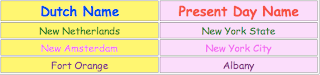


But the Dutch needed more people to settle here, so they set up a group of businessmen called the Dutch West India Company to try to get more people to come. This is how it worked: they called on rich men, called patroons, to persuade people to move to the New World. The patroon was given large amounts of land (mostly along the Hudson River) in exchange for bringing 50 settlers here. Now the settlers would not be given the land here; they were allowed to farm it in return for giving the patroon part of their crops and livestock as rent. This didn't work well, and many patroons failed and then quit, so the rules were changed. More people were then allowed to own land, and therefore, more people came here.

With more Dutch people, came more Dutch influences. Because the Dutch mainly lived around the Albany and New York City Area, many of their customs, building styles, food recipes, and city and street names are still found in those areas. Everywhere in New York State we still enjoy Dutch food (waffles, donuts, etc.) and some sports (like bowling). Did you know that lettuce and tomatoes were both brought to the new world by the Dutch?

Between 1624 and 1664, about one half of the colonists were Dutch, but the second largest group was the English. They came for religious freedom, better farmland, or to trade because New Amsterdam was a rich trading city. By 1664, Great Britain decided it wanted control of this colony and sent powerful British warships into New Amsterdam. Most Dutch did not want to fight this powerful British navy, so they gave up the colony without a shot being fired!

The British King then renamed it New York, after James, Duke of York, and set up a goal to increase the population. He immediately changed the names of Albany and New York City (see chart above), but the British encouraged people from different cultures and countries to live here. At one time they say there were 18 different languages being spoken on the streets of New York City!


Of course the biggest British influence on New York is the fact that we speak English as our language! We have also adopted many of their customs. It is also thought that our Constitution was directly influenced by the British Magna Carta.


New arrivals kept coming to the New World. Included in those groups were the French Huguenots. They wanted to practice a Protestant belief and were forced from France for doing so. In New York, the Huguenots could practice their religion, so in 1678 they settled up the Hudson River Valley around the present day cities of New Paltz and New Rochelle. Their influences on the area were many. Many French names are still found there. The Huguenots were a very hard working people, and they showed and shared their new farming methods with other settlers. They also believed in men and women having equal opportunities for education. They also provided the area with many fine artisans and craftsmen, including lace makers, clock makers, and furniture makers. After about 50 years, the French language began to disappear because of the increased Dutch and English population.

All three nationalities greatly influenced who we are, where we live, what we do, and how we talk!


DEFINITIONS

settlements: the process of establishing a permanent home in a new region

British: of Great Britain

Dutch: of the Netherlands

colony: a group of people settled in another land who are ruled by the government of their native land

rules: a law of conduct created by an authority (e.g. parents, school, or government)

artisan: a skilled person who makes something with his/her hands

patroon: rich Dutchmen who were given money by the Dutch government in return for supplying "farmers" for New Netherlands in the new country.

QUESTIONS:

1. Who were the first Europeans to settle in present day New York?


2. What was the Dutch name for Albany?


3. New York City was first named _________ by the Dutch?


4. A rich man who was given a large amount of money in return for getting people to settle in the new country was called?


5. What was New Netherlands renamed when the English took control of it?


6. The process of establishing a permanent home in a new region is called making a(n) ______________.


7. An adjective to describe people or things from Great Britain is __________________.


8. A group of people settled in another land who are ruled by the government of their native land is a(n) _________________.


9. A skilled person who makes something with his/her hands is a(n) ________________.


10. Laws of conduct created by an authority (e.g. parents, school, government) are called _____________.

Wednesday, November 17, 2010

Thanksgiving Day Web Quest


Thanksgiving Day is a day set aside each year in the United States and Canada for giving thanks and remembering the blessings of life. People may celebrate the day with family gatherings, feasting, and prayer. For many people, Thanksgiving calls forth memories of tables crowded with food, happy reunions, football games, and religious contemplation.

For thousands of years, people in many parts of the world have held harvest festivals. The American Thanksgiving Day grew out of these harvest home celebrations. For this reason, the holiday takes place late in the fall, after the crops have been gathered.

More than any other American holiday, Thanksgiving Day is surrounded with tradition, myth, and legend…one legacy of thanksgiving that has endured and remains true to the historical record is the theme of generosity—for three days in the autumn of 1621, some of the native inhabitants of New England (American Indians) joined more recent arrivals from England (The Pilgrims) in sharing the gifts of the land with each other. Each November, American continue this tradition with family and friends.


American Indians have a long tradition of celebrations of thanks for the bounties of the earth. Europeans have also held autumn harvest festivals and feasts for centuries. In 1619, a group of 38 English settlers arrived at Berkeley Plantation, near what is now Charles City, Virginia, on December 4. The group’s charter required that the day of arrival be observed yearly as a day of thanksgiving to God.

Plymouth Colony. The Plymouth Colony was founded by English pilgrims in 1620 at the site of a deserted Wampanoag Indian village called Patuxet. The colonists’ first winter in Plymouth was harsh, and about half of them died. In the spring of 1621, however, a Patuxet Indian named Tisquantum—called Squanto by the English—showed them how to plant traditional Native American crops of corn and pumpkin in addition to their European peas, wheat, and barley. In early autumn of 1621, the governor of Plymouth, William Bradford, organized a festival to give thanks to God for the survival of the colony and for their first harvest.

The festival lasted three days. Tradition holds that the colonists invited Massasoit, the Wampanoag chief, although some versions of the story claim he came to negotiate a new land treaty. He arrived with about 90 of his people and contributed five deer to the feast. The women of the settlement supervised cooking over outdoor fires. Foods served probably included duck and turkey; a corn porridge called nasaump; and a pumpkin dish called pompion. The English and Wapanoags played games and engaged in contests of skill, and the English held a military review. The colonists held similar harvest celebrations for several years. The Wampanoags did not always participate. Good relations between the colonists and the Indians eventually ended because of disputes over land, religious beliefs, and cultural traditions.


Later Thanksgiving Days in the United States.

The custom of thanksgiving days spread from Plymouth to other New England colonies. During the American Revolution (1775-1783), the Americans observed eight special days of thanks for victories and for being saved from dangers. In 1789, President George Washington issued a general proclamation naming November 26 a national day of thanksgiving.

For many years, the country had no regular national Thanksgiving Day. But some states had a yearly thanksgiving holiday. By 1830, New York had an official state Thanksgiving Day, and other Northern states soon followed its example. In 1855, Virginia became the nation’s first Southern state to adopt the custom.

President Abraham Lincoln proclaimed the last Thursday in November 1863, as “a day of thanksgiving and praise to our beneficent Father.” Each year afterward, the president formally proclaimed that Thanksgiving Day should be celebrated on the last Thursday of November. But in 1939, President Franklin D. Roosevelt set it one week earlier to help business by lengthening the shopping period before Christmas. Congress ruled that after 1941 the fourth Thursday of November would be observed as Thanksgiving Day and would be a legal federal holiday.

Thanksgiving Day in Canada is celebrated in much the same way as in the United States. The first Canadian thanksgiving was celebrated in Newfoundland in 1578. The English captain Martin Frobisher held a ceremony to give thanks for surviving the long sea journey from England. Thanksgiving Day in Canada was formerly celebrated on the last Monday in October. But in 1957, the Canadian government proclaimed the second Monday in October to be the holiday.

Andrews, Melodie. "Thanksgiving Day." World Book Student. World Book, 2009. Web. 10 Nov. 2009.

1. What is Thanksgiving Day?

2. How do people celebrate?

3. What other celebration did Thanksgiving grow out of?

4. In what year was Plymouth Colony founded?

5. Who founded it?

6. What was the first winter in Plymouth like?

7. Who was Squanto and what did he do?

8. Who was William Bradford and what did he do?

9. In what year was the first Thanksgiving celebration held?

10. How long did it last?

11. What food was served?

12. What games were played?

13. How did Americans celebrate Thanksgiving during the Revolutionary War?

14. What happened in 1941?

15. What other country celebrates Thanksgiving?

Thursday, November 4, 2010

Veteran's Day Web Quest

DEFENITION - Veteran: a person who has served in a military force, especially one who has fought in a war

“TO HONOR VETERANS OF ALL WARS”

Raymond Weeks of Birmingham, Alabama, organized a Veterans Day parade for that city on November 11, 1947, to honor all of America's Veterans for their loyal service. Later, U.S. Representative Edward H. Rees of Kansas proposed legislation changing the name of Armistice Day to Veterans Day to honor all who have served in America’s Armed Forces.


In 1954, President Dwight D. Eisenhower signed a bill proclaiming November 11th as Veterans Day and called upon Americans everywhere to rededicate themselves to the cause of peace. He issued a Presidential Order directing the head of the Veterans Administration, now the Department of Veterans Affairs, to form a Veterans Day National Committee to organize and oversee the national observance of Veterans Day. In addition to fulfilling that mission, the committee oversees the annual production and distribution of the annual Veterans Day poster.


June 1, 1954: President Eisenhower signs HR7786, changing Armistice Day
to Veterans Day.


In 1968, Congress moved Veterans Day to the fourth Monday in October. However, it became apparent that the November 11th date was historically significant to a great many Americans. As a result, Congress formally returned the observance of Veterans Day to its traditional date in 1978.

The Veterans Day National Ceremony is held each year on November 11th at Arlington National Cemetery. At 11 a.m., a color guard, made up of members from each of the military services, renders honors to America's war dead during a tradition-rich ceremony at the Tomb of the Unknowns.

The President or his representative places a wreath at the Tomb and a bugler sounds “Taps.” The balance of the ceremony, including a "Parade of Flags" by numerous Veterans service organizations, takes place inside the Memorial Amphitheater, adjacent to the Tomb.

In addition to planning and coordinating the National Veterans Day Ceremony, the Veterans Day National Committee supports a number of Veterans Day Regional Sites. These sites conduct Veterans Day celebrations that provide excellent examples for other communities to follow. For a listing of these sites, please visit:
www.va.gov/opa/vetsday/regsites.asp.


PLEASE ANSWER THE FOLLOWING QUESTIONS:


1. What is a veteran?

2. Who organized the first veteran’s parade and when was it held?

3. Who was Dwight D. Eisenhower and what did he do in 1954?

4. In 1968 Congress moved Veteran’s Day to what date?

5. What happened in 1978?

6. When and where is the Veterans Day National Ceremony is held each year?

7. What does the President do at the ceremony?

Friday, October 29, 2010

You Are There!


Hello Explorers:

Pretend that you are about to become one of the original inhabitants of our region.

Describe your journey.

Give details of your thoughts and feelings and interactions with other people.

Be sure to include details from your research.

USE YOUR OWN WORDS!

Break your story up into four paragraphs:

1) The first paragraph can be introducing the character and why they’re leaving on their journey.

2) The second paragraph can be about the actual journey, things they run into, things that occur.

3) The third paragraph can be once they arrive at their destination, what they find and plan to do while they’re there.

4) The fourth paragraph can be the conclusion, how you feel about being in your new home.

You will write your rough draft in your social studies notebook and publish your final draft in a WORD document. You need to fill at least two pages in your notebook, but feel free to write more.

Tuesday, October 19, 2010

The First Inhabitants of our Region

The first inhabitants of our region were Native Americans. It is thought that the first people in New York originally came from Asia (Siberia) by way of the Bering Strait about 11,500 years ago. They have been in North America for 40,000 years, but it took them a while to get as far as New York! The hunters and gatherers constantly walked south (away from the glaciers) in search of food.


One of the animals hunted were mammoths, a giant elephant-like animal


They probably followed them over the land bridge shown on the map above and eventually got to what is now New York State. They stopped in New York, perhaps because of the good geographic location. Lake Ontario and New York's rivers provided food, water, and a means of transportation for these early New Yorkers. The Spring and Summer season proved long enough to grow crops, allowing these early hunters and gatherers to become farmers. This permitted them to stay in one place, to form villages.
How do we know how long the Native Americans have been here? Archaeologists have done some digging and have come up with some very old artifacts that date the presence of Native Americans in present day New York State back 11,500 years! The people did not write anything down then, so the only clues we have are what the scientists find buried in the ground. They have found such things as stone axes, projectile points (arrowheads), pottery or stone bowls, and fire rings. With knowledge, an archaeologist can date these materials and tell when people lived where.
From the artifacts we now know for certain that the first inhabitants in New York State were Native Americans, and they have lived here for over 10,000 years.

DEFINITIONS:

Inhabitants- person who lives in an area

Bering Strait - a narrow body of water separating Asia and North America at Alaska

Native American - an American Indian

Archaeologists- a scientist who studies artifacts to learn about the past.

artifact - an object made by people who lived in the past.

Please answer the following questions:

1. Who were the first inhabitants of our region?

2. Where did the first people in New York originally come from?

3. How did they get here?

4. What is the Bering Strait?

5. Why did they walk south?

6. How long have these people been in North America?

7. What is a mammoth?

8. Why did they stop in New York?

9. What permitted them to stay in one place, to form villages?

10. How do we know how long the Native Americans have been here?

11. You have already defined the Bering Strait. How were the first inhabitants able to get across it?


Answer the questions in the comment section of the blog.

When you have finished answering the questions, choose the identity Anonymous and publish your comment.

Saturday, September 25, 2010

Grade IV / Unit I / Lesson I


Hello Students:

In your class you have begun a study Native American tribes in New York. Today, we will explore how the tribes got here and the different ways they lived and survived.


1) Click here to watch a short movie about American Indians. You must first log-in (username: ps376 password: ps376).

2) Take the graded quiz and raise your hand when you have a score.

Monday, September 20, 2010

Student Interest Survey


Hello Students:

In order to get to know you a little better (and learn how to save your work online), I would like you to fill out the following Student Interest Survey. It will be fun and interesting to find out about you. I will complete the survey too and when we're finished, we'll see what everyone had to say.

Directions:

1) Open a new WORD document.

2) Write your name and class number at the top of the page.

3) Copy and paste the questions from the class blog into the WORD document.

4) Save the document using YOUR NAME to the desktop.

5) Close WORD and the class blog.

6) Drag your WORD document from the desktop to your class folder

7) Drag the WORD document on the desktop to the TRASH.

8) Open the copy of your WORD document in your class folder.

9) Answer the questions in the survey.

10) Save and close your document.


Please answer the following questions using full sentences and proper punctuation:

1) What is your favorite song?

2) What is your favorite food?

3) What is your favorite movie?

4) What is your favorite T.V. show?

5) Where is your favorite place to be alone?

6) Where is your favorite vacation spot?

7) What was your most embarrassing moment? Why?

8) Who is your most admired person?

9) What is your favorite subject in school?

10) What is your favorite season?

11) Who is your favorite author?

12) What do you want to be when you grow up? Why?


REMEMBER:

Check your Writing!

1) Did I proofread my writing for spelling errors?

2) Does the first letter of each new sentence, as well as each proper noun (the names of people, places and things) begin with a capital letter?

3) Is “I” always capitalized?

4) Does every sentence end in a period (.), question mark (?) or exclamation point (!)?

5) Did I put one space between each word and two spaces after each period and between all sentences?

Tuesday, August 31, 2010

Orientation 2010

http://ps376grade5socialstudies.blogspot.com/


Topic: Introduction to Social Studies/Technology


My mission is to promote teaching and learning as core human activities dependent on relationship, passion and vision--in service to creativity, personal growth and a sustainable world.


Instructor: Mr. Almaas


Hello Students:

A new year and a new room!

Welcome to our Social Studies/Technology class. You are living during a time when we are experiencing the largest increase in expressive capability in human history. It will be a function of this class to help you become effective communicators in the media of your time.

We will be meeting here online every week where we will cover the social studies curriculum using technology.

Today you will be assigned a seat here in our, we'll go over the rules and then jump right in to our first assignment.

The Rules Of Our Class:

1) Be respectful of yourself and others.
2) Raise your hand to speak during class.
3) Listen quietly while others are speaking.
4) Always do your best!

Behavior Rubric


Grading

Each week you will be given an assignment to complete in class. If completed satisfactorily, you will get a check in the grade book beside your name as per the rubric below.


Social Studies/Technology Rubric

Check Plus = Information is accurate and useful. The theme or main idea of the
assignment is clear and related to the purpose or theme of the project.


Check = Information is clear and correct. The theme or main idea of the assignment is more or less clear and related to the purpose or theme of the project.


Check Minus = Completed week's assignment approaching standard. Information is
incomplete or not correct. The completed assignment does not have a clear purpose
or central theme.

No Check = Assignment was not completed.


Final Grade Rubric

All check pluses for the projects and weekly assignments, along with good behavior, during a grading period will result in a final grade of:

4

A mixture of checks and check pluses for the projects and weekly assignments, along with good behavior, during a grading period will result in a final grade of:

3

Too many check minuses and/or questionable classroom behavior during a grading period will result in a final grade of:

2

Too many check minuses, unexcused absences from class and poor classroom behavior during a grading period will result in a final grade of:

1


TODAY'S ACTIVITY

Today we have gone over the rules and procedures of our class, you watched a PowerPoint presentation showing many interesting sights around the Catskill Mountains and you learned how to sign in and access the online activities for this class.

Now you will notice New York State's geographical location in the United States by completing an online activity where it's up to you to point out where the 50 states go on a map of the United States:

Click the hyperlink above and begin.

Good luck!

Thursday, May 27, 2010

Memorial Day


Hello Students:

Today we will take a look at Memorial Day, a patriotic holiday in the United States of America, usually celebrated on the last Monday in May. Click here to read about Memorial Day. When you have finished, answer the following questions in your social studies notebooks.

1) What is Memorial Day?

2) Why was it originally celebrated?

3) Who does it honor now?

4) What city is is considered the birthplace of Memorial Day?

5) Who is Major General John A. Logan?

6) List four things people do to celebrate Memorial Day.

Friday, May 7, 2010

Slavery Ends


Hello Students:

Today you will be using an interactive timeline called the History of the United States. Before you visit this site, read the information below. Then click on the link below to begin.

* When the United States Timeline appears, drag your mouse to the right until you reach the year 1865.

* Click on the picture titled "Slavery Ends."

* There will be a red button at the bottom of the page that says, “read me.” Click it and read the paragraph that appears.

* This same paragraph will appear on each of the following pages, so you may review it whenever you click “read me.” You may hide the writing by clicking on the “hide me” button whenever you wish to view the whole picture.

* Look at all five of the photographs on slavery by clicking on the moving sprocket button in the bottom right-hand corner of each picture.

* When you are finished, return to this page by clicking on the “Back” button at the top, and answer the questions below in your social studies notebooks.

*You may go back and reread any time you wish.

If you are ready to begin, click here.

Can you answer these questions about slavery?

1. In what year was slavery outlawed in the United States?

2. What document ended slavery?

3. From what continent did most enslaved people come?

4. About how many enslaved people were shipped to the United States?

5. After slavery ended, Booker T. Washington founded Tuskegee. What is Tuskegee?

Tuesday, April 27, 2010

Slave Trade In The Colonies


Hello Students:

Today we will continue our study of the Slave Trade by going over some vocabulary terms.

Click here to play a matching game of Slave Trade vocabulary. When you have finished, write the terms down in your social studies notebook along with the definitions.

You will be using this information in the presentations you start working on next week.

Friday, April 16, 2010

The Colonial Slave Trade


Hello Students:

Today, we will continue our exploration of Slavery in New York City and New York State. Click here to read an advertisement offering a slave for sale. Copy down the questions below it in your social studies notebooks and answer the questions based on the information you glean from the advertisement.